Difference between revisions of "WATKINS, Carleton E."
| (4 intermediate revisions by the same user not shown) | |||
| Line 1: | Line 1: | ||
[[File:Watkins self-portrait.png| | [[File:Watkins self-portrait.png|400px|thumbnail|right|<center> </center>]] | ||
[[File:SEFI Sugarloaf.png|400px|thumbnail|right|<center> Sugarloaf Islands at Fisherman's Bay, Farallon Islands c. 1869 by Carl Watkins, Albumen silver print</center>]] | |||
<span style="color:#006400">'''WATKINS, Carleton Emmons'''</span> (1829–1916), an American photographer of the 19th century. Born in New York, he moved to California (with his boyhood friend, Collis Huntington) and quickly became interested in photography. Watkins focused mainly on landscape photos, and Yosemite was a favorite subject of his. His photos of the valley significantly influenced President Abraham Lincoln and the United States Congress’ decision to preserve it as a National Park. | <span style="color:#006400">'''WATKINS, Carleton Emmons'''</span> (1829–1916), an American photographer of the 19th century. Born in New York, he moved to California (with his boyhood friend, Collis Huntington) and quickly became interested in photography. Watkins focused mainly on landscape photos, and Yosemite was a favorite subject of his. His photos of the valley significantly influenced President Abraham Lincoln and the United States Congress’ decision to preserve it as a National Park. | ||
| Line 31: | Line 32: | ||
Image: Shag & Murre.png|<center>#2062. Shags and the Murre, Farallon Islands, c. 1870s<br>Photo by Carleton Watkins (1829–1916)</center> | Image: Shag & Murre.png|<center>#2062. Shags and the Murre, Farallon Islands, c. 1870s<br>Photo by Carleton Watkins (1829–1916)</center> | ||
Image:Watkins Gull, Shags & Murr.png|<center>#2063. Gull, Shags & Murr, Farallon Island, Pacific Ocean<br> (c. 1861-1873) <br>Carleton E. Watkins (1829–1916)</center> | Image:Watkins Gull, Shags & Murr.png|<center>#2063. Gull, Shags & Murr, Farallon Island, Pacific Ocean<br> (c. 1861-1873) <br>Carleton E. Watkins (1829–1916)</center> | ||
Image:2095 Watkins Farallones.png|<center>#2065. | Image:2095 Watkins Farallones.png|<center>#2065. The Oldest Inhabitant of the Farallone Islands.<br>Carleton E. Watkins (1829–1916)</center> | ||
Image:2072. Watkins. UCB.png|<center>#2072. The Oldest Inhabitant of the Farallone Islands.<br>Carleton E. Watkins (1829–1916)</center> | |||
Image:Watkins Seal Point.png|<center>#3789. Seal Point, Farallone Islands (c. 1861-1873) <br>Carleton E. Watkins (1829–1916)</center> | Image:Watkins Seal Point.png|<center>#3789. Seal Point, Farallone Islands (c. 1861-1873) <br>Carleton E. Watkins (1829–1916)</center> | ||
Latest revision as of 00:53, 18 September 2017


WATKINS, Carleton Emmons (1829–1916), an American photographer of the 19th century. Born in New York, he moved to California (with his boyhood friend, Collis Huntington) and quickly became interested in photography. Watkins focused mainly on landscape photos, and Yosemite was a favorite subject of his. His photos of the valley significantly influenced President Abraham Lincoln and the United States Congress’ decision to preserve it as a National Park.
Watkins began losing his sight in the 1890s. Towards the end of his life, he was declared incompetent and moved to the Napa State Hospital for the Insane in 1910. He died six years later and was buried in an unmarked grave on the hospital grounds.
Carleton Watkins = [1879] Frances Henrietta Sneade (1856-1945)
- Julia Watkins (1881-1977)
- Collis Milton Watkins (1883-1965) [named for his best friend, Collis Huntington, one of "the Big Four" owners of Central Pacific Railroad.
In the late 1860s, Watkins photographed the Farallon Islands outside San Francisco's Golden Gate.
- Farallon Islands Stereo Views

#2002. Light House at Farallone Islands, Pacific Ocean, c. 1875
Photo by Carleton Watkins (1829–1916) on Taber stock card.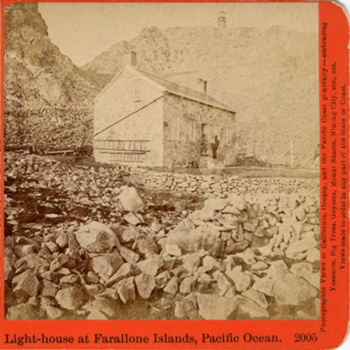
#2005. Light House at Farallone Islands, Pacific Ocean, c. 1875
Photo by Carleton Watkins (1829–1916) on Taber stock card.
#2043. Sea Lions, West End, Farallone Islands, P. O.
Photo by Carleton Watkins (1829–1916)
#2049. Sea Lions, West End, Farallone Islands, P. O.
Photo by Carleton Watkins (1829–1916)
#2055. Sea Lions, West End, Farallone Islands, Pacific Ocean.
Photo by Carleton Watkins (1829–1916)
#2061. Shags on their Nests, Farallone Islands, c. 1870s
Photo by Carleton Watkins (1829–1916)
#2062. Shags and the Murre, Farallon Islands, c. 1870s
Photo by Carleton Watkins (1829–1916)
#2063. Gull, Shags & Murr, Farallon Island, Pacific Ocean
(c. 1861-1873)
Carleton E. Watkins (1829–1916)
#2065. The Oldest Inhabitant of the Farallone Islands.
Carleton E. Watkins (1829–1916)
#2072. The Oldest Inhabitant of the Farallone Islands.
Carleton E. Watkins (1829–1916)
#3789. Seal Point, Farallone Islands (c. 1861-1873)
Carleton E. Watkins (1829–1916)


