Difference between revisions of "Isthmus, Santa Catalina Island"
| Line 45: | Line 45: | ||
<center><gallery widths=350px heights=300px perrow=2 caption="Santa Catalina Island Post Cards T-Series, Linen"> | <center><gallery widths=350px heights=300px perrow=2 caption="Santa Catalina Island Post Cards T-Series, Linen"> | ||
Image:5527 Newman Post Card Co.Inlet at Isthmus.jpg|<center> The Inlet at the Isthmus,<br>Santa Catalina Island, Cal. <br>Newman Post Card Co. <br>postmarked Aug. 5, 1907<br>[original in SCIF archives] </center> | |||
Image:C-43 The Isthmus.jpg|<center> C-43<br> The Isthmus, <br> Catalina Island, California</center> | Image:C-43 The Isthmus.jpg|<center> C-43<br> The Isthmus, <br> Catalina Island, California</center> | ||
Image:C-86 The Isthmus, San Clemente Island in Distance .jpg|<center> C-86 <br>The Isthmus, with San Clemente Island in Distance</center> | Image:C-86 The Isthmus, San Clemente Island in Distance .jpg|<center> C-86 <br>The Isthmus, with San Clemente Island in Distance</center> | ||
Image:1948 Isthmus.png|<center> C-86 <br>Isthmus, Santa Catalina Island, 1948</center> | Image:1948 Isthmus.png|<center> C-86 <br>Isthmus, Santa Catalina Island, 1948</center> | ||
Image:|<center> </center> | Image:|<center> </center> | ||
Image:|<center> </center> | Image:|<center> </center> | ||
Revision as of 02:18, 2 October 2020


Isthmus, Santa Catalina Island (Isthmus Cove, Two Harbors), was chosen as the site for the construction of Civil War barracks in 1863, although by September 1864 all military personnel had left the island. The drive to develop the isthmus began in 1899 when the Bannings owned all the land. They hoped to develop a resort, to be named Catalina City, that would rival Avalon. They planted Eucalyptus trees, built a new pier, and began building water and sanitation facilities. A large resort hotel to rival the Metropole, and a tent city was planned. In April 1903 the Massachusetts landscape architecture firm of Olmstead Brothers was hired to help with designs. In late 1903 the stage road to the Isthmus was completed, but in 1905, the Isthmus development project was put on hold. After the courts opened Avalon as a public port, the Bannings had renewed interest in creating their new resort, and in 1908 further improvements were made. In 1909, Joseph Brent Banning, (1861-1920), second son born to Phineas and Rebecca Banning, built his home at the Isthmus with commanding views of Two Harbors. Today this historic house serves as the Banning House Lodge.
William Greig managed the Isthmus and its concessions in the 1920s for William Wrigley, Jr. after his 1919 purchase of the island. Managers of the Isthmus include:
- William Greig 1920s
- D. M. Renton 1929-1930
- Art LaShelle 1930 to WWII and again into 1952
- COLLERs 1940s
- Doug Bombard 1958-1997
- John Phelps 1998-2007
Circling the Isthmus north from Isthmus Cove and Catalina Harbor there are seven large named rocks: Pin Rock, Whale Rock, Ribbon Rock, Eagle Rock, Indian Rock, Ship Rock, and Bird Rock.
The 1940 census lists the following as Isthmus residents:
- Harry Boosinger, 39
- Charles G. Anderson, 58
- Dorothy B. Lee, 45
- Oscar F. Giles, 37
Drownings at the Isthmus include
- O'NEILL, WIlliam (1890)
Wrecks at Inner Catalina Harbor (Isthmus) include: Ning Po Palmyra Margaret C. Charles F. Crocker
In the 1950s, Doug Bombard, son of one time mayor of Avalon, Al Bombard, managed the area for the Santa Catalina Island Company. Prior to Bombard, Preston Charles “Press” Taylor (1907-1984) had managed the area.
Today Isthmus Cove is a tourist destination, where one square mile of land is public. Four hundred moorings are supported off shore.
- Santa Catalina Island Post Cards T-Series, Linen
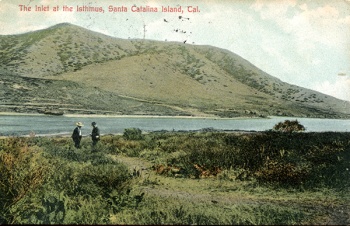
The Inlet at the Isthmus,
Santa Catalina Island, Cal.
Newman Post Card Co.
postmarked Aug. 5, 1907
[original in SCIF archives]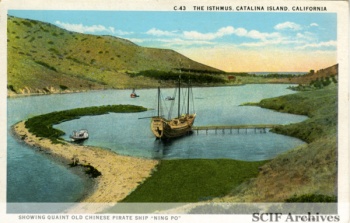
C-43
The Isthmus,
Catalina Island, California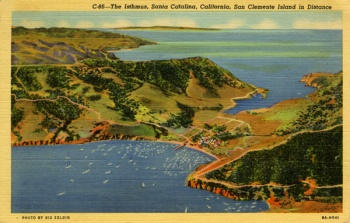
C-86
The Isthmus, with San Clemente Island in Distance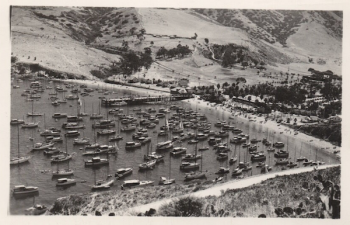
C-86
Isthmus, Santa Catalina Island, 1948


In the News~
June 12, 1864 [DAC]: “Letter from Santa Catalina Island. June 3rd, 1864... The Isthmus is a beautiful location, although treeless and uncultivated. It does not exceed a furlong in width, and in length scarcely exceeds half a mile. Its course is north and south and it has a harbor at each extremity. The north, or landward harbor is well situated for the small craft now engaged in trade from San Pedro. But a weird and bold scenery surrounds the south harbor, called, by way of pre-eminence, "Catalina Harbor." Though small, it is deep and almost landlocked, affording safe anchorage for vessels of large tonnage at almost all seasons of the year. The Isthmus is almost exclusively occupied by the military now stationed there. Captain West, the officer in command on the island, is a quiet, estimable gentleman, and a genial companion. His mild but firm discipline has endeared him to his men. Barracks are in process of erection, and it would be wisdom in the Government to be liberal in its appropriations for military improvements on the island of Santa Catalina...”
September 8, 1889 [LAH]: “Do not miss the grand moonlight ride between the Isthmus and Avalon, Wednesday night, the 9th.”
1897: “…The island is about twenty-two miles long and from three to eight miles wide. It is cut into almost two islands, for at the Isthmus it is but a quarter of a mile from sea to sea, though on either side there are lofty peaks. Two or three fishermen live at the Isthmus...” [Blanche Trask. Field Notes from Santa Catalina Island in Erythea 7:135, 1899].
1899: “Two or three fishermen live at the Isthmus...” [Trask, L. B. Field notes from Catalina Island in Erythea 7:135-146, 1899]
[1901]: “The stage line is now complete from Avalon to Eagles Nest, a distance of about 12 miles, so that there is a coach road from Avalon to the Isthmus, except about 5 miles. [Charles F. Holder, An Isle of Summer]. [Note: The road from Eagle’s Nest to Little Harbor was not complete by 1901.]
September 13, 1901 [LAT/SCat]: “Avalon. Captain Hancock Banning of the yacht La Paloma, with N. W. Bell and W. R. Staats, who have been cruising about for three weeks, returned to Avalon Bay yesterday afternoon, and left for San Pedro this morning, where their cruise will come to an end. They visited San Diego and Santa Barbara, and spent some days on Santa Cruz Island, and for some days have been lying at in Catalina Harbor at the Isthmus.”
March 11, 1903 [LAT/SCat]: “Avalon. The gathering of abalone pearls is an infant industry attracting some attention here. Wilson, the Isthmus fisherman, came down yesterday at the request of people here to dispose of a lot of pearls which he has accumulated. They are from the abalones, which have heretofore abounded about the island, but which are now becoming rather scarce. Wilson’s hoard of pearls numbers several hundred, but are mostly small, though some are of good size and perfect in shape. There are many ‘freaks’ among them, one being almost an exact representation of a shoe.”
April 12, 1903 [LAT/SCat]: “The Banning Company is projecting great things for Santa Catalina. The scene of their latest effort is at and in the vicinity of the Isthmus, where they will expend more than a million dollars in improvements. Olmstead Brothers, the greatest landscape architects in this country, have charge of the work of laying out the grounds, not alone about the Isthmus, but they will lay out a park boulevard extending from the Isthmus to Emerald Bay, a distance of four miles and intersecting half a dozen canyons en route. The boulevard will be down close by the water’s edge, and will be practically level, at no place having a greater grade than 2-1/2 percent. It will have an average width of 60 feet. At no point will it be less than 30 feet, and in many places it will be full 100 feet in width. It is part of their plan to connect the stage road running from Avalon to Eagle’s Nest, with that leading from the Isthmus to Little Harbor, the connecting link to be built being about six miles…”
December 30, 1903 Catherine MacLean Loud writes in her diary: “The Stage Company are building two barns, one at the Isthmus and one in Avalon. They each stable 30 horses and provender. The road to the Isthmus is now completed.”
February 2, 1904 [LAT/SCat]: “Avalon. The business men of Avalon had a gala time yesterday afternoon and evening when they went in a body to make a call on B. F. Latimer, the host of ‘The Barracks’ at the Isthmus…”
February 4, 1904 [LAT/SCat]: “Avalon. The Isthmus trip by stage and return thence by boat is proving very popular.”
April 22, 1904 [LAT/SCat]: “Avalon. The mystery of the unusual activity at the Isthmus is solved. Rev. B. Fay Mills is behind the scheme. Mill has conducted several summer schools, or camp meetings, and it is his purpose to spend the summer — from the middle of June to September 1 — at the Isthmus, where he will preach to the large body of campers which, it is to be expected, will be attracted. It is figured that thousands interested in the Mills philosophy and who love to sit within the sound of his voice, will follow him to the Isthmus, there to have a pleasant outing and at the same time imbibe divine truth as it trickles from the eminent evangelist’s lips. The scheme is to be worked out on a very liberal plan. An amphitheater, the lumber for which was shipped from San Pedro today, capable of seating 5000 persons, is to be built, and to make room for the building the pretty little park which now ornaments the place, will be sacrificed. It is expected that from 25,000 to 30,000 people will be drawn to the Isthmus during the season. A large number of tents, in addition to those now being taken from Avalon, will be placed for their accommodation. About seventy-five mechanics are now on the ground at the Isthmus and the number is increased daily by twenty-five or thirty…
April 30, 1904 [LAT/SCat]: “Avalon. C. A. Bryant, proprietor of the stage line, gave a picnic to a party of friends yesterday taking them to he Isthmus on one of his stages. The start was made at 8 o’clock, a perfect day favoring the excursionists… Arriving at the Isthmus, and lunch being disposed of, Mr. Bryant, leaving nothing undone for the entertainment of his guests, took them over the speedway, only just completed, to Emerald Bay, a most charming drive. At 4:30 they boarded the Meteor for the trip by water home, arriving at 5:30.”
June 13, 1904 [LAT/SCat]: “Avalon. The Warrior came over last evening with a party of Southern Pacific railroad men… The night was spent at Hotel Metropole, and this morning the party went by stage to the Isthmus, stopping at Middle Ranch for luncheon.”
June 28, 1904 [LAT/SCat]: “Avalon. Camp Cabrillo, formerly the Isthmus, is to be opened July 15. A number of visitors have already taken quarters there. The improvements at the place include many trees planted. The program of the series of literary and other entertainments to be given in the course of the six weeks following the opening has been partly prepared.”
July 1, 1904 [LAT/SCat]: “Avalon. C. A. Bryant, owner of the Catalina stage line, took L. J. Rose Jr., of Oxnard, and his family through to the Isthmus yesterday by stage. Mr. Rose is one of the largest farmers of Ventura County. He raises beans, lemons and walnuts, having sold a grove of 160 acres of the latter.”
July 27, 1904 [LAT/SCat]: “Avalon. The yacht Ramona carried a picnic crowd to the Isthmus and White’s Landing today.”
August 5, 1904 [LAT/SCat]: “Avalon. The bowling alleys which were put into the old Island Villa dining room when that hostelry was removed to its present site, have been taken out and are being removed to the Isthmus.”
August 8, 1904 [LAT/SCat]: “Avalon. There was considerable excitement here yesterday because of the rivalry which has been generated between the Meteor Boat Company and the Avalon Company, both of which have maintained barbecue excursions twice a week all through this season, giving a dinner at the Isthmus…”
September 4, 1904 [LAT/SCat]: “Avalon. The Meteor Company gave another barbecue at the Isthmus yesterday, about sixty people participating.”
September 8, 1904 [LAT/SCat]: “Avalon. The restaurant at the Isthmus was closed for the season yesterday, but there is a general store and numerous tents so that persons choosing to go there to camp can get supplies… The Meteor carried fifty people to the Isthmus on its barbecue excursion yesterday.”
April 21, 1914 [TI/Avalon]: “Hancock Banning and a party of friends, on the yacht Cricket, visited Avalon Friday. After a trip to the Isthmus, the party returned to San Pedro.”
July 14, 1914 [TI/Avalon]: “Captain William Banning spent the weekend on the island, making a trip to the Isthmus Sunday.”
November 17, 1914 [TI/Avalon]: “The Isthmus. Its possibilities as a pleasure resort unequaled. But few residents in Avalon realize the possibilities the Santa Catalina Island Company has for making the Isthmus an attractive pleasure resort, in competition with Avalon… Objections have been raised owing to the wind at the Isthmus, but the old barracks, and other buildings show no more signs of inclement weather, than do any structures in Avalon after a three days winter storm. On cottages which have not been used for years, the shingles are yet intact…”
July 27, 1915 [TI/Avalon]: “Mr. and Mrs. J. B. Banning and family arrived Saturday, and left for their beautiful summer home, which overlooks Isthmus harbor. The family are planning to spend the summer on the island.”
September 14, 1915 [TI/Avalon]: “Mr. Hancock Banning and party arrived on the yacht Velero Saturday night, leaving for the Isthmus Sunday morning.”
September 28, 1915 [TI/Avalon]: “The daily trips to the Isthmus made by the Cornell and the Greeley Stage Coach Company are still well patronized by tourists and others. The dinner and the interesting explanation of the many points of interest by Mr. Cornell are features of the boat trip.”
April 4, 1916 [TI/Avalon]: “Mr. and Mrs. J. B. Banning and family are to remain for several weeks at the Isthmus.”
August 8, 1916 [TI/Avalon]: “More campers are at the Isthmus this season than there has been for many years. Daily runs are made by the launch Cornell, and ‘good time’ exclamations can be heard from those who participate…”
August 15, 1916 [TI/Avalon]: “Every day the launch Cornell, Captain George N. Cornell, leaves Avalon for the Isthmus.”
August 15, 1916 [TI/Avalon]: “A big blast that will probably jar the whole island will be touched off by Superintendent Collings at the government quarry near the Isthmus this morning. Five tons of dynamite will be discharged.”
August 22, 1916 [TI/Avalon]: “Fifteen thousand tons of rock were blown off the top and side of the hill at the Isthmus quarry by the recent heavy blast. Further large explosions are being prepared for, which will probably be set off some day this week.”
March 12, 1918 [TI/Avalon]: “Narrowest point on the island, where it is less than half a mile from water to water. The site of a future town built by the owners of the island, the Banning Brothers. Great preparations are making to beautify this locality, and splendid boulevards, villa sites and a fine hotel are under contemplation. Several thousand trees have been planted and are making a fine growth. On February 5, 1864, Captain R. B. West, commanding at the Fourth California Infantry, stationed at the Isthmus, gave orders for all miners to leave the island. The government barracks is still intact at the Isthmus.”
March 12, 1918 [TI/Avalon]: “Howland’s — Here also were many mining claims, and here yet may be found ‘prospects’ which would turn the head of many a mining prospector. Ere is the well from which water is pumped to the Isthmus.”
March 12, 1918 [TI/Avalon]: “C. B. Parker and A. B. Chappell have been repairing the slight washes in the auto mountain stage road, which is again passable through to the Isthmus.”
August 19, 1977 [LAT]: “…The long, low building sitting on a rise above the Isthmus village is now the Isthmus Yacht Club. Many visitors don’t know it was built in 1864 by the Union Army as a lookout station for Confederate raiding ships…”
